Ready to Build a Role-Based AI Training and Transformation Roadmap?
ISHIR helps organizations move from scattered AI experimentation toward structured adoption, practical workforce enablement, and AI-powered workflow implementation..

“One employee is learning to summarize an email. Another is building an AI agent. Why are they in the same AI training?”
This is one of the most overlooked problems in enterprise AI adoption.
Organizations are investing in AI licenses, employee training, internal workshops, and productivity tools. Yet many continue to approach AI education as though everyone has the same starting point, the same responsibilities, and the same learning needs.
Consider three employees in the same organization.
A finance manager is experimenting with ChatGPT to summarize monthly reports. A marketing director is already using AI to automate campaign research, content workflows, and customer segmentation. Meanwhile, a software engineer is building autonomous agents that connect enterprise systems and execute multistep tasks.
All three need AI training.
They do not need the same training.
McKinsey’s 2025 State of AI research found that 78% of surveyed organizations used AI in at least one business function, up from 72% earlier in 2024. Yet widespread usage does not establish that organizations have redesigned workflows, developed employee capabilities, or achieved meaningful financial returns.
That gap creates a leadership problem.
Companies are measuring AI adoption by how many employees attend training or activate a license, when they should be measuring how effectively employees apply AI to their actual work.
A successful AI training strategy in 2026 must recognize two dimensions:
The goal is to build a workforce that can use AI appropriately, improve real workflows, and develop advanced solutions where the business case supports them.
For CEOs, CIOs, CHROs, and transformation leaders, that requires a different approach to AI workforce development.
The first enterprise AI training challenge is assuming that employees share a common level of understanding.
In reality, AI maturity varies considerably, even among people with similar titles.
One project manager may be uncomfortable entering a prompt. Another may already be using AI to prepare project updates, identify delivery risks, and analyze dependencies.
Putting them through the same introductory course creates two problems.
Beginners become overwhelmed when instructors move too quickly. Experienced users disengage when training repeats concepts they already understand.
Both outcomes waste time and reduce confidence in the program.
Microsoft and LinkedIn’s 2024 Work Trend Index found that 75% of surveyed knowledge workers were already using AI at work, while 78% of AI users were bringing their own AI tools.
Although these figures describe 2024, they help explain a challenge that remains relevant in 2026: employees often develop AI habits independently of formal organizational programs.
Deloitte’s State of Generative AI in the Enterprise research also documented organizational barriers involving trust, governance, talent, and the difficulty of scaling AI beyond experimentation.
The implication is straightforward. Training programs cannot assume that an employee who has never attended a formal AI course has never used AI.
The first question should be: What can our people do today, and what do they need to do next?
Many companies use a binary definition of AI readiness.
Employees are either trained or untrained. Departments are either using AI or not using AI.
Neither classification provides enough information to make good investment decisions.
A more useful approach recognizes a progression of capabilities.
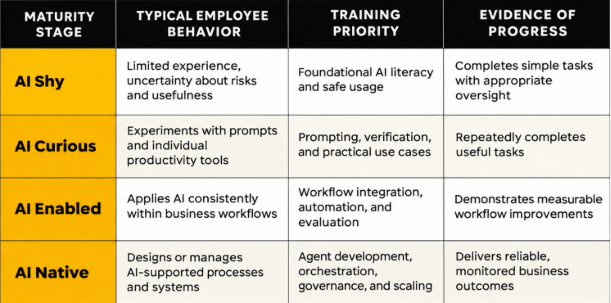
This maturity model gives leadership a more precise way to allocate resources.
An AI Shy employee may need a safe environment to experiment with basic tools. An AI Enabled employee may need access to approved enterprise data and automation platforms.
An AI Native engineer may need advanced instruction in agent orchestration, evaluation frameworks, identity management, and system integration.
Training budgets should follow these differences.
The maturity model should guide development, rather than become a permanent label attached to employees.
An employee can be AI Native in one workflow and AI Curious in another.
AI skills become valuable when employees apply them to work they actually perform.
A generic course on prompt engineering may teach useful techniques. It does little to explain how a procurement manager should evaluate supplier proposals or how a controller should investigate unusual financial transactions.
This distinction matters because executives are looking for operational results.
McKinsey’s 2025 AI research found that organizations were using AI across business functions, including marketing, sales, product development, and service operations. The potential value, risks, and implementation requirements differ considerably across those functions.
The objective is to connect learning to the actual decisions, systems, and responsibilities of each role.
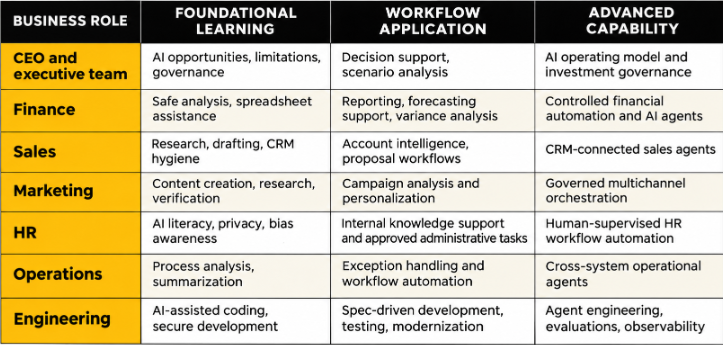
Training becomes more useful when employees can answer a simple question: How will I use this in my job tomorrow?
Some executives assume basic AI training is becoming unnecessary because employees already have access to ChatGPT, Microsoft Copilot, Gemini, and similar tools.
Access does not establish competence.
Employees still need to understand when AI is useful, how outputs can fail, what information they can share, and when human review is required.
The 2025 World Economic Forum Future of Jobs Report identified AI and big data among the fastest-growing skills, while estimating that 59 out of every 100 workers would need training by 2030.
That creates a broad workforce development challenge.
Foundational learning should teach employees how to formulate useful requests, provide relevant context, evaluate answers, protect confidential information, and recognize limitations.
It should also explain approved tools, company policies, and escalation procedures.
The emphasis should be on practical competence rather than technical terminology.
Foundational training should give employees enough confidence to experiment responsibly without encouraging them to trust every output.
McKinsey’s November 2025 State of AI survey found that 88% of respondents reported regular organizational AI use in at least one business function, up from 78% in 2024. Yet only 39% reported enterprise-level EBIT impact from AI.
These are different measures, but the gap is instructive. Adoption is widespread, while enterprise-level financial impact remains less common.
Deloitte’s 2026 State of AI in the Enterprise report found that just 34% of surveyed organizations were fundamentally reimagining their businesses around AI.
Organizations need employees who can recognize where AI fits within an end-to-end process.
For example, an accounts payable team might begin by using AI to extract invoice information.
The next level involves integrating extraction with purchase-order matching, exception routing, and human approval.
The advanced level might involve an AI agent that monitors invoices, identifies discrepancies, prepares recommendations, and updates authorized systems after approval.
Each level requires different skills.
The real opportunity begins when employees learn to redesign the work surrounding AI.
As organizations expand AI adoption, some employees develop capabilities far beyond everyday productivity applications.
They begin building custom assistants, automations, AI agents, retrieval systems, and integrations.
Forcing these employees to repeat introductory AI literacy training wastes their time.
But allowing them to develop enterprise AI solutions without engineering standards introduces risks.
McKinsey’s 2025 research found that 62% of surveyed organizations were experimenting with or scaling AI agents, while agent deployment remained concentrated in a limited number of business functions. McKinsey
Deloitte’s 2026 research reported that only one in five surveyed companies had a mature governance model for autonomous AI agents. Deloitte US
The challenge is developing advanced capabilities alongside appropriate controls.
For technical employees, the curriculum may cover:
Business-side advanced users need a different curriculum. They may learn to configure approved automation platforms, define agent requirements, build evaluations, and manage exceptions without developing production software themselves.
Advanced training should result in reusable capabilities that other teams can adopt safely.
AI adoption challenges are partly technical. They are also human.
Employees may worry about making mistakes, exposing confidential information, losing control over their work, or eventually losing their jobs.
Others may feel embarrassed that colleagues are progressing faster.
A company-wide training session can amplify these concerns when participants have very different experience levels.
Employees who are uncomfortable asking basic questions may remain silent. More advanced employees may dominate the conversation.
Leaders need to make AI learning accessible without treating every employee as a beginner.
The World Economic Forum’s 2025 Future of Jobs Report found that 63% of surveyed employers identified skills gaps as a major barrier to business transformation. World Economic Forum
That finding extends beyond AI, but it helps explain why skills development must be treated as part of organizational change.
Employees need clarity about what the organization expects them to learn and how their responsibilities may change.
Employees are more likely to participate when they understand what successful AI use looks like and feel safe admitting what they do not know.
Organizations sometimes separate AI training into two programs.
One teaches employees how to use AI tools. Another explains governance, security, and compliance.
That separation can create a dangerous gap.
An employee who knows how to automate a workflow but does not understand data permissions may expose sensitive information. A technically capable developer may deploy an agent that performs actions beyond its intended authority.
Governance should be taught in the context of the task.
A sales employee needs to understand customer-data handling. A finance employee needs controls around financial accuracy and approval. An AI engineer needs to understand access controls, tool permissions, prompt injection, monitoring, and recovery procedures.
The NIST AI Risk Management Framework provides a useful reference for organizing AI governance around the functions Govern, Map, Measure, and Manage.
Organizations can use it to connect employee learning with risk assessment and operational oversight.
The goal is to teach employees how to use AI responsibly within the authority of their roles.
One of the biggest weaknesses in enterprise learning programs is measuring activity instead of outcomes.
Executives often receive reports showing training hours, completion percentages, course satisfaction, and licenses activated.
Those measures help administrators understand participation.
They do not establish whether the investment improved business performance.
For CEO AI strategy in 2026, learning metrics should connect to operational metrics.
Suppose a finance team of 20 employees spends four hours each week preparing recurring management reports.
That represents 80 hours of weekly effort.
After workflow-specific AI training and process changes, assume the same reporting output requires 50 hours weekly, with no decline in quality.
The potential time saving is 30 hours per week.
At an illustrative loaded labor cost of $60 per hour, that represents $1,800 of weekly capacity, or $93,600 over 52 weeks.
This is a hypothetical example, not a documented client result.
The $93,600 should not automatically be treated as cash savings. The organization must establish whether the recovered capacity reduces paid costs, avoids additional hiring, or supports other valuable work.
It must also subtract training, software, integration, oversight, and maintenance costs.
Training ROI becomes easier to defend when business leaders own the outcome alongside learning teams.
A one-time AI workshop has a limited shelf life.
Tools change. Models improve. Governance requirements evolve. New opportunities emerge as employees become more capable.
Organizations need a learning system that adapts to these changes.
Deloitte’s 2026 research found that 53% of surveyed organizations were educating their broader workforce to improve AI fluency, while 48% were developing upskilling and reskilling strategies. Only 33% reported redesigning career paths and mobility strategies in response to AI. Deloitte US
Education is receiving attention. Connecting it to changing work and career development remains a challenge.
At ISHIR, we believe organizations should organize AI workforce development around two complementary efforts.
Track A: Broad workforce AI enablement
This track develops practical AI literacy and role-specific application across the organization.
It includes foundational skills, safe usage, prompt techniques, output verification, and workflow improvement.
Track B: Advanced AI builders and transformation leaders
This track develops employees who can design, integrate, evaluate, and manage AI-supported business systems.
It includes advanced business practitioners, technical builders, product owners, and executive sponsors.
The tracks should share governance standards and business objectives. Employees can progress between them as their capabilities and responsibilities change.
The objective after 90 days is to have evidence about which training approaches improve work, which need adjustment, and where additional investment makes sense.
ISHIR works with enterprises, midmarket organizations, and growth-stage businesses to connect AI strategy, workforce enablement, workflow redesign, and implementation.
As an AI-native system integrator and AI-powered software development partner, ISHIR approaches AI training as part of a larger business change.
An employee who learns to use AI more effectively may improve personal productivity. But when the organization wants to automate a workflow or deploy an agent, it also needs the right data, integration architecture, engineering, governance, and operational support.
Our approach starts by understanding the business problem and the capabilities employees need to solve it.
AI maturity assessment and strategy: Evaluate current employee capabilities, identify role-specific gaps, and establish a practical AI adoption roadmap.
Executive AI enablement: Help CEOs, CIOs, CTOs, and business leaders understand AI opportunities, investment decisions, governance, and measurable outcomes.
Role-based AI workshops: Design practical learning around the workflows employees perform in finance, operations, marketing, sales, technology, and other functions.
Data + AI Accelerator: Assess data readiness, identify valuable use cases, establish governance priorities, and develop an actionable implementation plan.
AI agent and workflow engineering: Design, build, integrate, and evaluate AI-supported workflows using enterprise data and systems.
AI-native product engineering: Apply spec-driven development, AI-assisted engineering, testing, and modern delivery practices to accelerate software initiatives with appropriate controls.
Through our Innovation Acceleration Workshop, we help organizations establish clarity around business problems, priorities, success metrics, risks, and execution plans before committing substantial resources.
The goal is to connect learning investments to capabilities that employees can use and the organization can measure.
ISHIR helps organizations move from scattered AI experimentation toward structured adoption, practical workforce enablement, and AI-powered workflow implementation..
Role-based AI training is an approach that adapts AI education to employees’ responsibilities, experience, and business workflows. It recognizes that executives, finance professionals, marketers, and software engineers use AI differently. Training covers the capabilities each role needs, from basic AI literacy to workflow automation and advanced development. The objective is to improve job performance while maintaining appropriate governance and human oversight.
Employees enter training with different levels of AI experience and technical confidence. A beginner may struggle with advanced automation concepts, while an experienced practitioner gains little from introductory prompting exercises. Generic training can also fail to connect AI capabilities with employees’ daily responsibilities. Segmenting learning by maturity and role makes training more relevant and allows organizations to measure practical improvement.
A practical model includes foundational AI literacy, workflow application, and advanced AI building. Foundational learning teaches safe use, prompting, and verification. Workflow application teaches employees to improve recurring business processes with approved AI tools. Advanced training covers designing, integrating, evaluating, and operating AI-powered systems and agents.
Companies should combine practical exercises, role-specific evaluations, and evidence of actual AI usage. Assessments should cover basic understanding, output verification, data handling, and workflow application. Technical employees may also be assessed on system design, integration, testing, and governance. Results can be mapped to maturity stages such as AI Shy, AI Curious, AI Enabled, and AI Native.
AI adoption describes whether people or organizations are using AI tools. AI maturity describes how effectively, safely, and systematically those capabilities are applied. An employee may use ChatGPT every day without understanding how to validate its outputs or integrate it into a reliable workflow. A maturity assessment examines demonstrated competence and the ability to produce useful results.
Every employee should understand basic AI capabilities, limitations, safe prompting, and output verification. Employees also need to know their organization’s approved tools and data-handling policies. They should practice applying AI to routine tasks appropriate to their roles. More advanced skills can follow when business responsibilities require them.
Executives need enough AI literacy to make informed investment and governance decisions. Their curriculum should cover business opportunities, implementation risks, workforce implications, and AI economics. They should learn to evaluate use cases, challenge unsupported ROI assumptions, and establish accountability. Executive training should also address how AI may change organizational workflows and operating models.
Business users generally need skills in AI-assisted analysis, workflow improvement, verification, and approved automation tools. Developers need additional knowledge of software architecture, APIs, agent frameworks, evaluations, security, and deployment. Both groups require an understanding of governance and human oversight. Cross-functional exercises help them translate business requirements into dependable technical solutions.
An initial program can be designed, piloted, and evaluated within approximately 90 days, depending on organizational complexity. The first month typically focuses on assessment, governance, and curriculum design. The following weeks involve practical training and supervised workflow experiments. Building organization-wide capability takes longer and requires continuing measurement and improvement.
Organizations should compare operational performance before and after employees apply their training. Useful measures include cycle time, error rates, rework, cost per transaction, and output quality. Financial calculations should account for software, training, implementation, and maintenance costs. Executives should distinguish between time saved, productive capacity recovered, and actual financial savings.
Common challenges include uneven employee capabilities, insufficient workflow integration, poor data readiness, unclear governance, and difficulty measuring financial returns. Employee concerns about accuracy, security, and job changes can also affect participation. Organizations may struggle when AI initiatives lack accountable business owners. Addressing these barriers requires coordinated leadership across technology, operations, HR, finance, and risk management.
Organizations should provide agent-building training when employees have relevant responsibilities and there is a credible business need. Advanced business users may learn to configure governed automation tools, while engineers develop deeper integration and evaluation skills. Training should cover permissions, testing, monitoring, and human intervention. Production agents require clear ownership and controls appropriate to the consequences of their actions.
Leaders should explain why AI is being introduced and how it may affect employees’ work. Training should accommodate beginners without making them feel judged against more experienced colleagues. Managers should provide time to practice and recognize responsible experimentation. Transparent communication about changing roles and development opportunities can help build trust.
Organizations should review AI learning content at least quarterly and sooner when important tools, policies, or risks change. Technical curricula may require more frequent updates because development practices evolve quickly. Employee maturity assessments should also be repeated to identify new capabilities and gaps. Updates should be guided by operational results rather than the release of every new AI product.
ISHIR helps organizations assess AI readiness, identify valuable use cases, and establish practical implementation priorities. Its work spans AI strategy, data readiness, workflow design, system integration, and AI-native product engineering. This allows organizations to connect employee learning with the technical and operational changes needed to apply AI at scale. The focus is on measurable business outcomes, controlled implementation risk, and sustained capability development.
The next phase of enterprise AI adoption requires more thoughtful investment in people.
Some employees need to understand what AI can do.
Others need to learn how to apply AI to the work they already perform.
And some are ready to design entirely new workflows, products, and AI-powered systems.
A single curriculum cannot serve all three groups equally well.
For CEOs and business leaders, the opportunity is to build an AI learning strategy that recognizes where employees are today, where their roles are going, and what capabilities the organization needs.
Clarity before training. Capability before automation. Evidence before expansion.
AI should accelerate human judgment, not replace it.
The companies that make the most of AI will need employees who know when to use it, how to challenge its outputs, and how to improve the work around it.
The post Your AI Training Program Needs More Than One Starting Line appeared first on ISHIR | Custom AI Software Development Dallas Fort-Worth Texas.


