
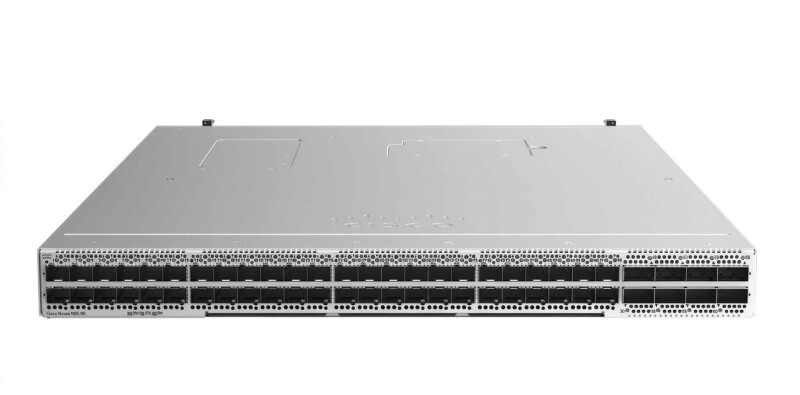
Server consolidation has led Cisco to boost the speed of top-of-rack switches to 100G.
The networking giant last week announced the catchily named N9348C8D-H2, a 1U device packing 48 100G SFP-DD ports and eight 400G QSFP-DD uplinks.
At the Cisco Live event in Melbourne, Australia, this week, Cisco’s senior veep for datacenter and internet infrastructure, Kevin Wollenweber, said one reason the company created the device is that modern servers often feature a pair of fast network interface cards.
The twin cards are needed because sixth-gen server processors from Intel and AMD offer dozens, or even hundreds, of physical processor cores and therefore generate a lot of traffic.
The density of computing power those processors provide has led chipmakers and server manufacturers to suggest replacing handfuls of machines running older, power-guzzling Xeons and Epycs with boxes running more efficient sixth-gen chips.
The Register hears it’s not uncommon to achieve 6:1 server consolidation ratios when moving from third- or fourth-generation Xeons or Epycs to current models. Users who make that move can pack many more server cores into the same rack. Power bills go down, but the quantity of data leaving a rack goes up.
Wollenweber said Cisco realized it had “tons” of switches that offer 25G ports but felt it had a gap in its range for non-AI scenarios like server consolidation that produced increased data flows.
The exec admitted that the 100G ports may be overkill for a modest collection of new servers, but argued users recognize it won’t be long before they grow into the excess capacity – perhaps as they use more agentic AI applications.
Cisco sees traffic from AI agents stressing the north-south connections that link organizations to the cloud and also driving much more east-west traffic across internal networks.
At Cisco Live, the company’s execs suggested that network upgrades are therefore an inevitable necessity.
That’s not entirely self-serving, because agents will vastly outnumber humans and constantly create traffic, compared to the flurries of network activity that happen when humans use generative AI or chatbots.
Cisco argues that deploying agents at scale will therefore only be possible on highly automated networks.
“Humans can no longer comprehend the amount of data that we actually have in a network,” Wollenweber told The Register.
Cisco’s Canvas agentic operations platform aims to at least make humans aware when their attention is needed, by detecting problems and offering to make repairs.
Joe Vaccaro, Cisco’s senior vice president and general manager for Network Platform and Assurance, told The Register he believes network administrators don’t feel threatened by suggestions from AI agents when they concern familiar, routine, low-risk tasks that IT pros are confident the agents can handle. Over time, he said, networking pros will learn to trust agents with more complex work. ®


