
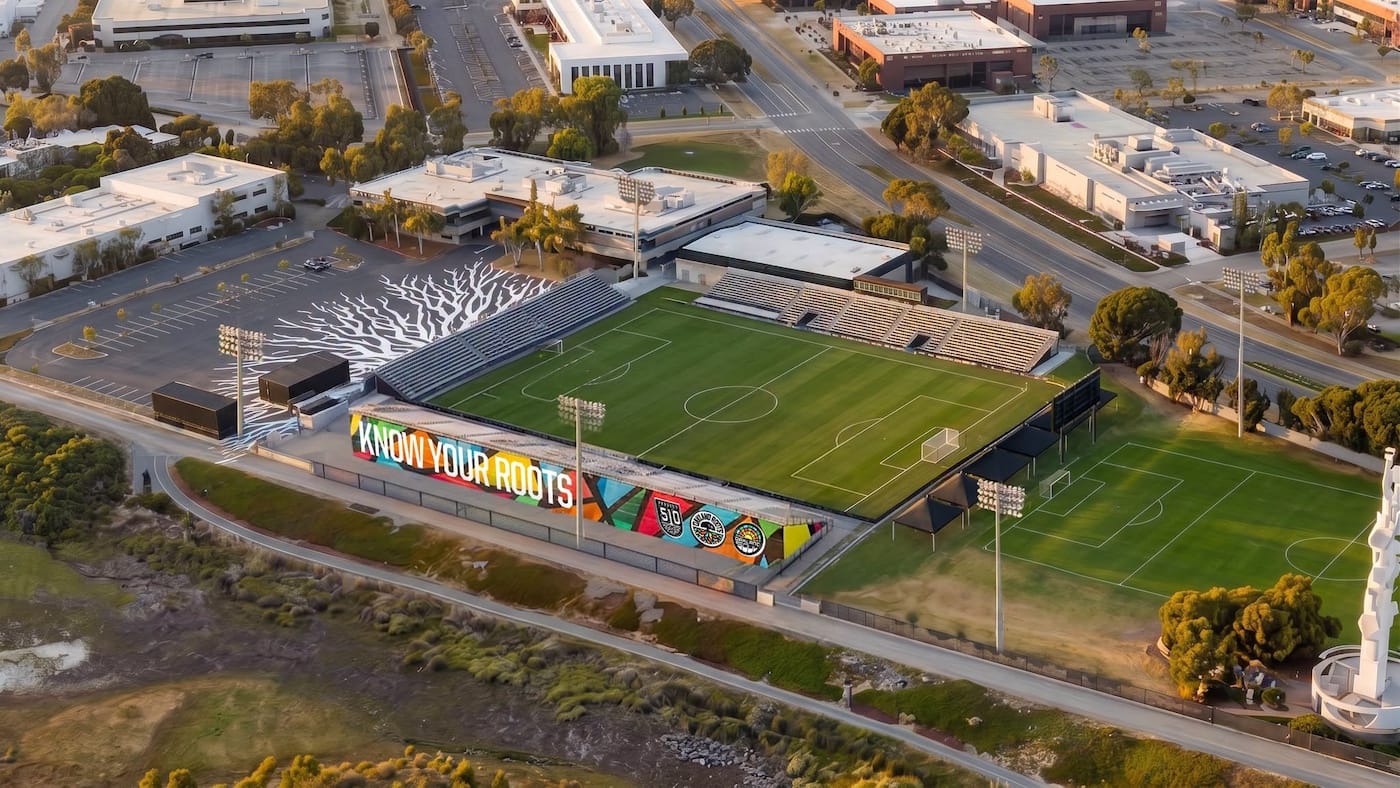
The Oakland Roots are preparing to move their home games to Alameda for the 2027 season, with plans to turn their existing training facility into a temporary stadium while the club pursues a permanent stadium in Oakland.
The Alameda Planning Board approved plans Monday evening to install temporary stadium stands, lighting, and other facilities at 1150 and 1120 Harbor Bay Parkway, where the Roots currently train, as the SF Business Times reports.
The Alameda facility, which formerly served as a practice complex for the Oakland Raiders, has extensive parking, locker rooms, workout facilities, and corporate offices. Several national teams also used the property as a training site during the 2026 FIFA World Cup.
According to Bay Area News Group, the proposed stands would accommodate up to 8,000 spectators, and the club is expected to provide shuttle service for BART riders traveling from Coliseum Station. City Council approval is still expected in the coming weeks.
The move marks another chapter in the club's increasingly nomadic history. Founded in 2019, the Roots initially played at Laney College for a few years before spending the 2023 and 2024 seasons at Cal State East Bay in Hayward.
The team appeared to have found a longer-term home at the Coliseum in 2025, reportedly drawing more than 26,000 fans for its home opener, but the arrangement proved financially unsustainable, as SFist reported in July. Roots President Lindsay Barenz announced over the summer that the club would not seek another season at the Coliseum.
Weeks later, stadium officials disclosed that the team had accumulated $1.4 million in unpaid lease obligations. Henry Gardner, executive director of the board overseeing the Coliseum property, recently told the Business Times that the outstanding balance had since been reduced to approximately $700,000, with discussions ongoing about repayment.
Gardner noted that the deficit ultimately affects Oakland and Alameda County taxpayers.
The club has also acknowledged that playing at the Coliseum wasn't profitable, although Barenz defended the decision, pointing to the economic benefits for Oakland and the hundreds of stadium workers who had jobs during the games.
“In hindsight, you can look back and say, ‘Well, that was not a profitable decision.’ And if you read our financial statements, that’s probably true,” she told the News Group. “But for the bottom line of Oakland and the people of Oakland, it rebounded to their favor in multiples, and I’m really proud that we did that.”
Still, there are reportedly questions about whether the temporary stadium can be ready before the Roots' season begins in March. The current plans guarantee just 1,500 dedicated parking spaces, considerably fewer than the proposed stadium's capacity, and traffic congestion on match days remains a concern. If construction falls behind schedule, the team could be forced to play its opening games on the road, losing out on ticket revenue.
The club, which also operates the Oakland Soul women's team and a youth development academy, launched a $15 million fundraising campaign earlier this month to stabilize its finances, as the News Group reports. The Soul, which played at Merritt College this past season, is also expected to relocate to the Alameda facility.
Meanwhile, the Roots are still pursuing a permanent stadium at Oakland's Howard Terminal waterfront, where the Oakland A's previously proposed building a ballpark, as SFist reported in September. The club and development partner Industrial Realty are expected to present more detailed proposals to Port of Oakland officials by mid-December.
“The goal is to exist in Oakland 100 years from now,” Barenz told Bay Area News Group, while acknowledging the difficulty of securing enough investment to make even the 2027 season possible.
Previously: Oakland Coliseum Loses Its Last Team as Oakland Roots Soccer Club Announces Move


